Towards a vaccine for Alzheimer's?
For years, there has been slow progress towards a treatment for Alzheimer's disease. But the latest scientific developments are promising. From immunotherapy, which we already know from cancer treatments, to a vaccine: our alzheimer's specialist Prof Dr Rik Vandenberghe explains.
In Belgium, more than 200,000 people have Alzheimer's disease or another form of dementia. Among people over 60, the disease will affect about one in five women and one in seven men. Despite decades of intensive research, there is no cure yet.
Prof Dr Rik Vandenberghe, neurologist at UZ Leuven: “Patients are still prescribed the same drugs today as they were 20 years ago. The medication we give to Alzheimer's patients today has a slightly beneficial effect on cognitive symptoms. Unfortunately, those drugs only fight the symptoms, not the disease itself. And their efficacy is limited.”
Immunotherapy
Therefore, scientists continue to search for more effective treatments. One promising avenue is immunotherapy. “In Alzheimer's disease, we see abnormal accumulations of amyloid and tau proteins in the brain. These play a direct role in the onset of the disease and cognitive symptoms. Amyloid forms clumps between nerve cells, while tau accumulates inside nerve cells, forming tangles. The tangles are closely linked to the nature and severity of a patient's symptoms. For years, researchers have been trying to develop antibodies against those proteins so that our own immune system could clear them out. A kind of immunotherapy, in other words, as is already used today in various forms of cancer.”
Removing the unwanted proteins via immunotherapy can be done in two ways: actively or passively. In the passive form, the patient receives antibodies through an infusion into the blood. The first tests with those study drugs started around 2008.
Many initial studies showed no effect or were stopped because of side effects. But since 2020, there is hopeful news: three antibodies against amyloid did well in clinical trials and two of them, lecanemab and donanemab, are now on the market in the US. They are currently being evaluated by the European Medicines Agency (EMA).
“Despite the fact that only one per cent of the antibodies get through the blood-brain barrier and they are quickly broken down in the body, they still prove very effective in counteracting amyloid clots in the brain. After a year and a half, in about 80 per cent of treated patients, the amount of amyloid in the brain is almost completely back to normal levels.”
Washing away protein plaques
So does this have the hoped-for therapeutic effect? “The recent studies show that patients with those antibodies are more likely to remain stable during a treatment period of a year and a half, although the effect is rather small. Moreover, patients sometimes have side effects because amyloid is also found in the blood vessel walls in the brain. When it is removed, those walls become more porous and fluid may seep out of the blood vessels, which may cause small and sometimes larger haemorrhages. Treatment should therefore be monitored regularly with brain scans.”
“The fact that we can wash away the amyloid clots from the brain with medication, and thus influence the disease process, is revolutionary. But the effect on symptoms is smaller than we would like. Therefore, it is essential to continue the search for drugs that specifically act on the disease mechanisms.”
Active immunisation, the other form of immunotherapy, is also the subject of many studies. “You can compare it to a classic vaccine: patients are injected with a fragment of the pathogenic protein so that their own immune system produces antibodies against it. The big advantage is that this treatment needs to be administered less often. Several vaccines are in development and the first results of some of them are promising. But we see that, for now, the removal of the harmful protein clumps is much less than with the current passive form of immunotherapy.”
Preventive vaccine?
Could we use such an alzheimer's vaccine preventively against the disease? “In theory, that is indeed possible. For example, a new study on the long-term effect of active immunisation against the tau protein will start soon, in which UZ Leuven is also participating. This will be done in study volunteers who do not yet have any symptoms, but in whom brain scans show an increased amount of amyloid and tau in specific parts of the brain.”
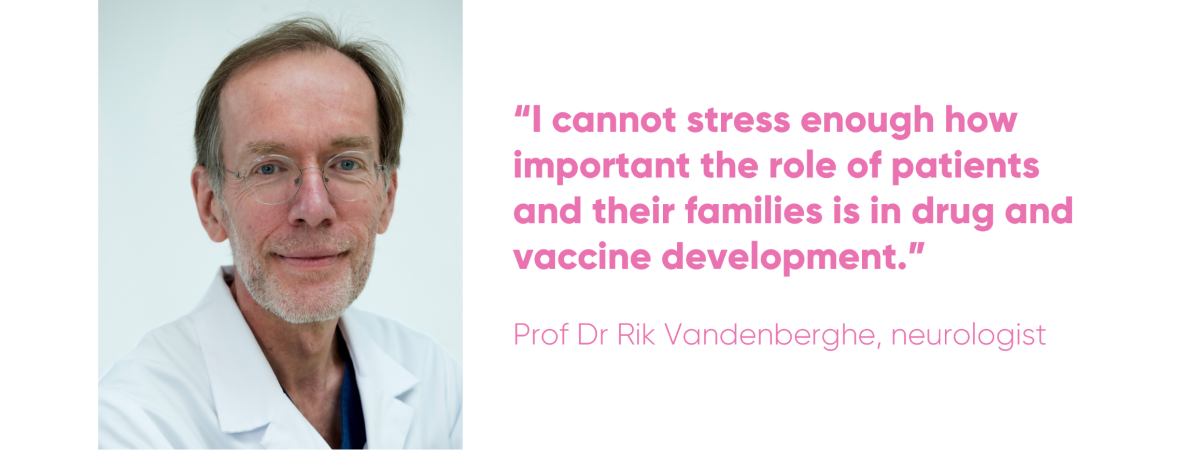
Clearly, much research is still needed to achieve real breakthroughs. “I cannot stress enough how important the role of patients and their families is in drug and vaccine development. Their willingness to participate in studies, despite the sometimes unprecedented risks, largely drives progress towards better treatments. Even studies with negative results are very instructive. This is proven by the recent surge in immunotherapies for Alzheimer's: for a decade, that research did not look bright, but even those disappointing studies are finally starting to bear fruit.”
(This article appeared first in UZ-magazine by UZ Leuven, May 2024)